
Guide · Quebec Law
Charter of the French Language (Bill 96)
Quebec's Charter of the French Language, as amended by Bill 96, now reaches contracts, packaging, trademarks, signage, websites and the workplace. This guide explains each obligation and its effective date, including the June 2025 trademark and signage rules and francization for businesses with 25 or more employees, and how the OQLF enforces them.
Key takeaways
- Contracts of adhesion must be offered in French first since 1 June 2023.
- Descriptive terms in trademarks on products must also appear in French since 1 June 2025.
- Exterior signs with non-French trademarks need markedly predominant French since 1 June 2025.
- Employers must provide employment documents and job offers in French.
- Businesses with 25 to 49 employees must register for francization since 1 June 2025.
The Charter of the French Language after Bill 96
The Charter of the French Language makes French the official language of Quebec and the normal language of work, commerce and business. Bill 96, the Act respecting French, the official and common language of Québec, received assent on 1 June 2022 and substantially strengthened the Charter. According to the Office québécois de la langue française (OQLF), most amendments took effect on assent, while others were phased in on 1 June 2023 and 1 June 2025. The obligations apply to businesses operating in Quebec regardless of where they are headquartered, and the OQLF states that language-of-work obligations apply regardless of size or federal jurisdiction.
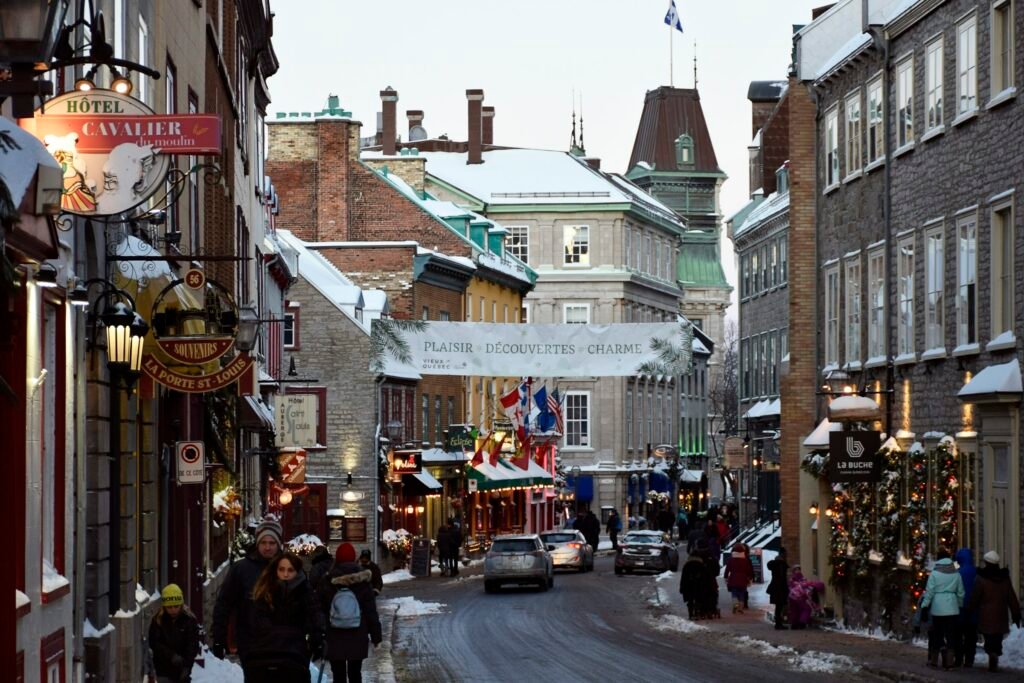
For businesses, the Charter touches almost every customer-facing and employee-facing document. This page explains the requirements for contracts, products and packaging, signage and trademarks, websites and advertising, employment and francization, and how the OQLF enforces the Charter. It reflects OQLF guidance updated in 2026 and should be read with the Charter and its regulations, which prevail over guidance.
| Obligation | Effective date | Who is affected |
|---|---|---|
| French in employment communications, documents and job offers | 1 June 2022 | All employers in Quebec |
| French version of contracts of adhesion before binding in another language | 1 June 2023 | Businesses using standard-form contracts with Quebec counterparties |
| Francization registration for businesses with 25 to 49 employees | 1 June 2025 | Mid-sized employers |
| Generic and descriptive terms in trademarks on products also in French | 1 June 2025 (with transition to 1 June 2027 for some products) | Manufacturers, importers, retailers |
| Markedly predominant French on exterior signs showing a trademark in another language | 1 June 2025 | Retailers and businesses with storefronts |
Contracts and the Charter of the French Language
The Charter distinguishes between contracts of adhesion and negotiated contracts. A contract of adhesion is a standard-form contract whose essential terms were imposed by one party and were not negotiable. Since 1 June 2023, according to the OQLF, a business must provide a French version of a contract of adhesion to the other party before the parties can agree to be bound by a version in another language. If no French version is provided, the business cannot hold the other party to the contract in another language. The OQLF notes that this rule does not cover contracts used for relations outside Quebec.
Negotiated contracts can be drawn up in another language if that is the express wish of the parties, and many commercial agreements include a clause recording that choice. Related documents, such as invoices, receipts and documents relating to a contract, are subject to their own French requirements. Some contracts, including certain contracts with parties outside Quebec and some financial and loan instruments, have specific exceptions.
What businesses should do
- Identify every standard-form contract used with Quebec customers, suppliers or partners, including online terms and purchase orders.
- Prepare French versions and provide them first, with a mechanism for the other party to choose another language.
- For negotiated contracts in English, include a clause recording the parties' express wish.
- Check that invoices, receipts, warranties and user documents meet French requirements.
Products, packaging and labelling
Inscriptions on a product, its container or wrapping, and documents supplied with it, such as directions for use and warranty certificates, must be in French. Another language may also be used, but not with greater prominence than French. These rules apply to products sold in Quebec, whether made in Quebec or imported, and affect manufacturers, importers, distributors and retailers.
Trademarks on products
The Charter allows a recognized trademark to appear on a product only in a language other than French, but the exception has narrowed. According to the OQLF's guidance on trademarks on products, updated 29 September 2026, if a French version of the trademark is registered, it must appear on the product. Since 1 June 2025, generic and descriptive terms included in a trademark, such as words describing ingredients, colour, scent or other characteristics, must also appear in French on the product or on a medium permanently attached to it.
The OQLF describes a transition to 1 June 2027 for products manufactured before 1 June 2025 where no French version of the trademark had been filed as of 26 June 2024, and for certain food products covered by new federal labelling rules. Our trademarks and brands page explains how this interacts with federal trademark registration.
Signage and commercial advertising
Public signs, posters and commercial advertising must be in French. They may also be in another language, provided French is markedly predominant in the cases set out in the regulations. Since 1 June 2025, where a business name with a specific term in another language or a recognized trademark wholly or partly in another language is displayed on a sign visible from outside premises, it must be accompanied by French terms, such as a generic term, a description or a slogan, that ensure the marked predominance of French.
According to the OQLF's signage guidance, French text must occupy at least twice the space of the text in the other language and have at least equivalent visibility and legibility, including lighting. On dynamic signs, French must be displayed at least twice as long. Signs inside premises that are not visible from outside, vehicles, and standalone structures showing more than two business names or trademarks are among the exceptions to the predominance rule. Information such as hours, telephone numbers and addresses does not count toward predominance. If a French version of the trademark is registered, that version must be displayed.
Websites and digital commerce
Commercial websites, online catalogues, apps and social media advertising directed at Quebec consumers are subject to the same principles as other commercial publications: French must be available, and another language may be used alongside it. E-commerce businesses should ensure that the French version is at least as complete as other versions, including checkout pages, terms and customer service channels.
The language of work
The Charter of the French Language gives workers the right to carry on their activities in French. Employers must communicate in French with employees, provide individual and collective communications, offers of employment, transfers and promotions, and documents relating to employment such as contracts, policies and training materials, in French. An employee may request an individual contract of employment in another language. Job offers published in another language must be published simultaneously in French with comparable means of transmission.
Employers may not require knowledge of, or a specific level of knowledge of, a language other than French for access to a position unless the nature of the duties requires it and the employer has taken all reasonable means to avoid imposing the requirement, including assessing actual language needs, ensuring that existing language knowledge is insufficient and restricting the number of positions requiring another language as much as possible. Employees are protected against reprisals for exercising their language rights, and the OQLF indicates that reprisal complaints must be filed within 45 days. Our Quebec employment and regulatory page covers other workplace rules.
Software, technology and internal tools
The language-of-work rules extend to the tools employees use. Where a French version of software, including operating systems, business applications and internal platforms, is available on the market, the Charter's francization framework expects businesses to make it available to employees, and francization programmes address the use of French in information technology. Global companies that deploy English-only enterprise software across all countries should check whether French versions or interfaces exist and plan migrations, especially for customer service and point-of-sale systems used daily in Quebec.
Business names
Enterprise names used in Quebec must comply with the Charter: a name in another language may be used only if accompanied by a French generic term, and the French version of a name must be used where one exists. Names must be declared to the Registraire des entreprises du Québec. Businesses entering Quebec under a foreign brand often add a French descriptive term to the name used on signs and documents, which also helps meet the signage rules. Our incorporation checklist covers registration steps.
Francization obligations
Francization is the process by which a business ensures that French is generalized at all levels of its operations. Businesses with 50 or more employees in Quebec over six months must register with the OQLF, provide an analysis of their language situation and, where needed, adopt and implement a francization programme to obtain a francization certificate. According to the OQLF, since 1 June 2025, businesses employing 25 to 49 people must also register to begin the francization process. Businesses with 100 or more employees must establish a francization committee.
Francization programmes cover the language of internal communications, the use of French in information technology and software, terminology, signage, product documentation and the language skills of management. Businesses should start early: preparing the analysis and programme takes time, and the OQLF expects concrete, measurable progress over the life of the programme. Our francization obligations insight explains the process step by step, from registration to certification.
Count your Quebec workforce regularly. Crossing the 25- or 50-employee threshold triggers registration obligations within set periods, and growing businesses often miss the moment they cross the line. Build the threshold into HR reporting.
Enforcement and penalties
The OQLF handles complaints and investigations and can issue orders. According to the OQLF, it must generally give at least 15 days' notice before issuing an order under s. 177 of the Charter, and failure to comply with an order can lead to penal prosecution. Decisions can be contested before the Tribunal administratif du Québec. The Charter provides for fines that increase for repeat offences, and in some cases the OQLF can seek injunctions or the suspension or revocation of permits, licences or francization certificates. Contracts entered into in breach of certain requirements may also be challenged by the other party.
In practice, many businesses first hear from the OQLF after a consumer or employee complaint. A prompt, documented response showing a credible plan to correct the issue, with dates and responsible persons, is usually the best way to avoid escalation to an order or prosecution.
Common compliance gaps
Complaints to the OQLF tend to involve a predictable set of issues: English-only websites or apps, packaging where the French text is less prominent than another language, storefront signs with a foreign trademark and no French descriptor, English-only job postings or employment contracts, and English-only standard terms. Each is relatively easy to correct before a complaint, and much more disruptive to fix under an order with a deadline. A periodic audit of these items, particularly after a rebrand, a product launch or the opening of new locations, catches most problems. Businesses should also brief their marketing agencies and franchisees, because their materials often create the gaps.
Relationship with federal law
Federal laws, such as the Consumer Packaging and Labelling Act and the Food and Drug Regulations, also impose bilingual labelling requirements for many products sold in Canada, and the federal Use of French in Federally Regulated Private Businesses Act adds its own regime for federally regulated employers. Businesses need to satisfy both the federal rules and the Charter of the French Language, which can differ in detail, for example on how trademarks and descriptive terms are treated.
Dealing with the Quebec civil administration
Bill 96 also changed how the Quebec government communicates with businesses. According to the OQLF, government departments, agencies, municipalities and bodies in the education and health networks must, subject to exceptions, use French exclusively in their communications with legal persons and enterprises established in Quebec, and in their contracts, permits and similar documents. Businesses dealing with public bodies, including bidders on public contracts, should expect to receive and submit documents in French. Where a company's head office is outside Quebec, some exceptions may apply, but it is prudent to plan for French-language submissions in any procurement or permitting process.
A compliance plan for the Charter of the French Language
Compliance with the Charter of the French Language works best as a project with an owner, a budget and a timetable. A practical plan has six steps:
- Inventory: list contracts, packaging, signage, websites, advertising, software and employment documents used in Quebec.
- Gap analysis: compare each item against the Charter and the regulations, prioritizing high-visibility items such as storefronts and online terms.
- Trademark strategy: decide whether to register French versions of key marks and add French descriptors where needed.
- Translation and terminology: use qualified translators and consistent terminology, including for software interfaces used by employees.
- Workforce: review job postings and language requirements, and plan francization registration.
- Governance: assign responsibility for ongoing compliance and complaint handling.
How TRW & Co helps
We help Canadian and international businesses comply with the Charter of the French Language. Our work includes reviewing contracts and online terms, packaging, signage and advertising, trademark strategy with registered agents, job posting and language requirement assessments, francization registration and programmes, and responses to OQLF complaints and orders. We work in English and French and coordinate with Quebec advocates where a matter proceeds before a tribunal or court. See also our Quebec law overview. This page is general information, not legal advice. To discuss a compliance question, contact us.
Frequently asked questions
Can my website be in English only if I sell to Quebec customers?
Generally no. Commercial publications directed at Quebec, including websites and online catalogues, must be available in French, and another language may be used alongside it. The French version should be complete, including terms, checkout and customer service information.
Can I keep my English trademark on products sold in Quebec?
Usually yes, if it is a recognized trademark and no French version is registered. Since 1 June 2025, however, generic and descriptive words in the mark must also appear in French on the product or a permanently attached medium, subject to a transition to 1 June 2027 for some products.
Do negotiated contracts have to be in French?
No. Negotiated contracts can be drawn up in another language if that is the express wish of the parties, and parties often record that choice in the contract. The French-first rule applies to contracts of adhesion, meaning standard-form contracts whose essential terms are not negotiable.
When must my business register for francization?
Businesses with 50 or more employees in Quebec must register with the OQLF within six months after reaching that level. Since 1 June 2025, businesses with 25 to 49 employees must also register to begin francization, according to the OQLF.
Can I require employees to speak English?
Only if the nature of the duties requires it and you have taken all reasonable means to avoid the requirement, including assessing real language needs and limiting the number of positions that require another language. Employees are protected against reprisals for asserting their language rights.
Sources
General information only, not legal advice. References to statutes, courts and authorities describe published law and practice at the date shown.